




Oceans

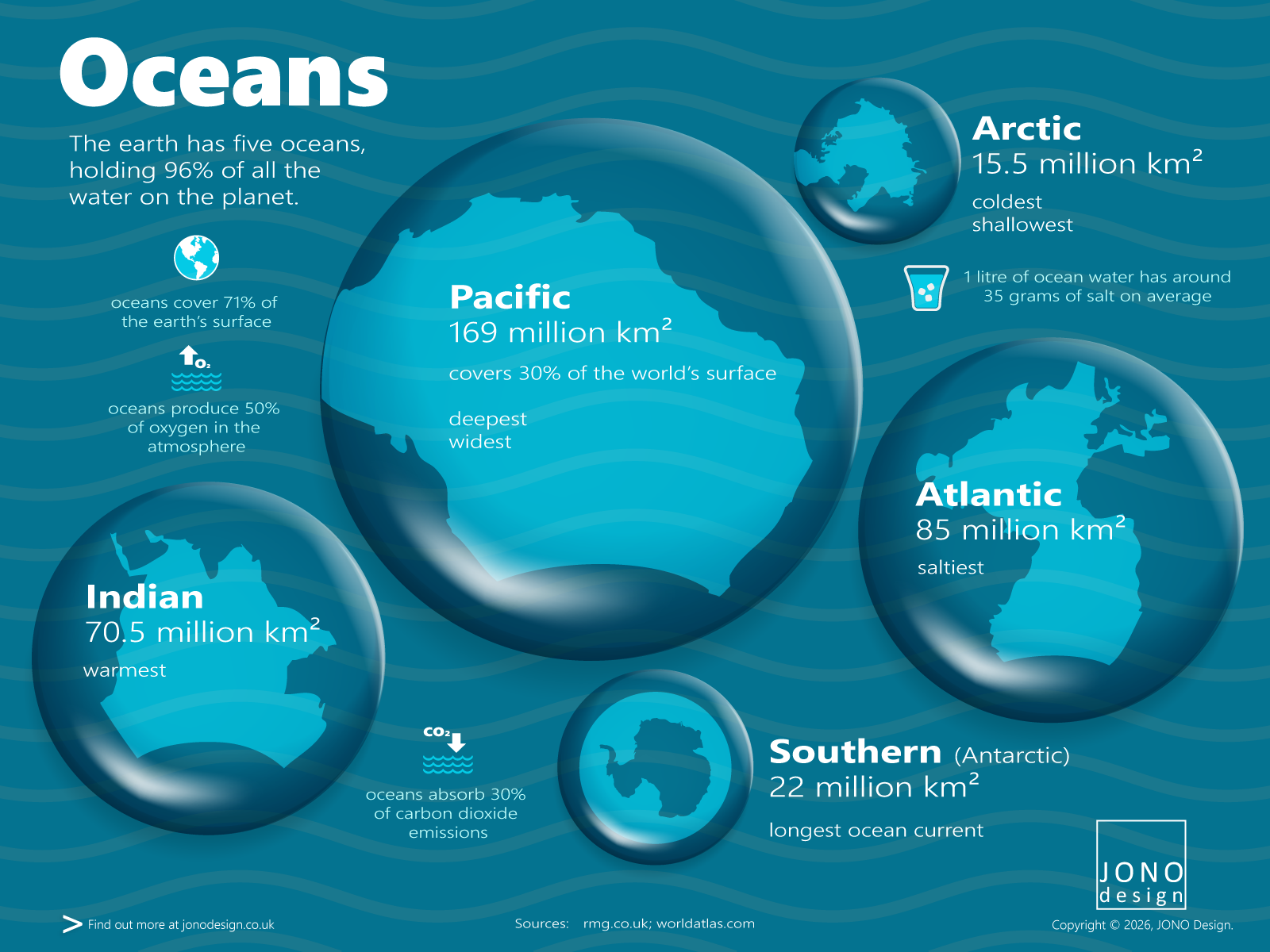
The world’s five oceans hold almost all of the water found on earth (96%). These saltwater bodies cover almost three quarters (71%) of the surface of our planet.
They are key for sustaining life as they produce around half of the oxygen in the atmosphere and act as carbon sinks, absorbing over 30% of the earth’s carbon dioxide emissions.
This infographic compares the sizes of each of the oceans, from the Pacific Ocean, which is the largest, to the Arctic Ocean, which is the smallest.
Click on the infographic to enlarge it.
Pacific Ocean
The Pacific is the largest ocean, at 169 million square kilometres, covering 30% of the world’s surface area. It is also the deepest ocean and contains the Mariana Trench which, at its deepest, measures 11 kilometres – so deep that the summit of Mount Everest would be more than a mile under the waves. In addition, the Pacific is the widest ocean, extending up to 19,800 kilometres at its widest point – equivalent to five times the diameter of the moon.
Atlantic Ocean
The second largest ocean, at 85 million square kilometres, is the Atlantic, covering around a fifth of the earth’s surface. The Atlantic is the world’s saltiest ocean. It is also home to the Sargasso Sea, the only body of water entirely defined by ocean currents rather than coastlines.
Indian Ocean
The Indian Ocean is the last of the ‘big three’, covering 70.5 million square kilometres. It has the warmest waters of all the oceans.
Southern Ocean (Antarctic)
The two smaller oceans are both found in the polar regions. The larger of the two, the Southern Ocean, covers 22 million square kilometres. It lies below the 60th line of latitude and surrounds the Antarctic continent, which is why it is also known as the Antarctic Ocean. The idea of its being an ocean is relatively new, that status having formally been proposed in 2000 and not yet universally accepted. The ocean contains the world’s longest current, the Antarctic Circumpolar Current, with a length of 21,000 kilometres.
Arctic Ocean
The Arctic Ocean is the world’s smallest, at 15.5 million square kilometres. Whilst it is the coldest ocean, the temperature in the Arctic region is warming two to three times faster than the world average. The Arctic Ocean is also the shallowest, on average being around only a third of the average depth of the Pacific.
Infographic design
The design uses a limited colour palette of blues and whites, reflecting the ocean subject matter. Circles styled as water droplets are used to visualise the size of each of the oceans. Each circle is in proportion to the others so that the oceans can easily be compared. Icons in the spaces around the circles are used to highlight some key general facts, adding interest and visual appeal.
Sources
rmg.co.uk
worldatlas.com
This infographic appeared in JONO Design e-news. The e-news is published once every couple of months and each issue contains a specially designed infographic.
Click on the orange button to sign up for JONO Design e-news.

Get in touch to discuss your design requirements
or to request a quote.

enquiries@jonodesign.co.uk

Copyright © 2015-2026 JONO Design.
Designing solutions with Word