




Flying Scotsmen

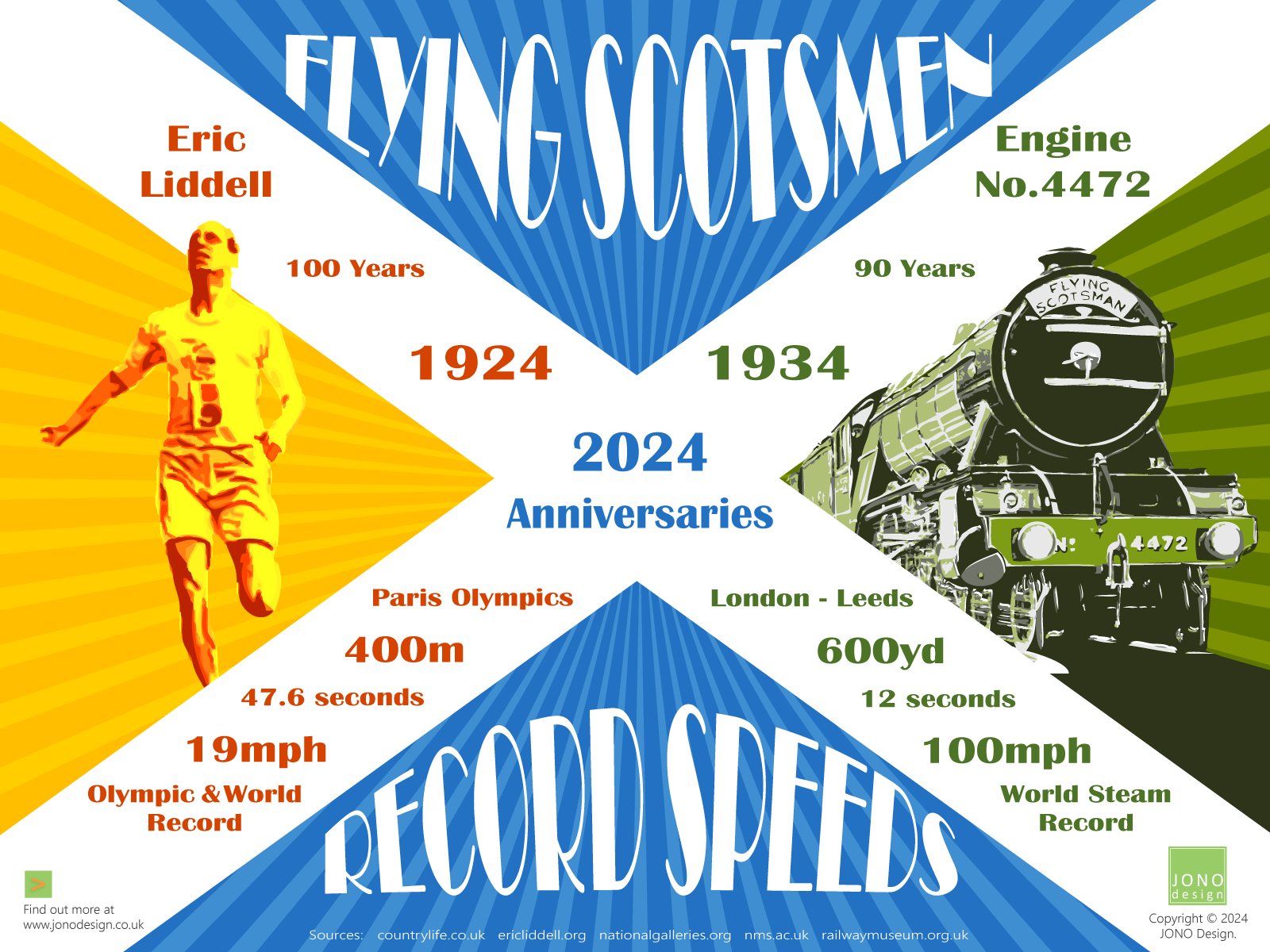
The nickname ‘Flying Scotsman’ has been given both to Eric Liddell, one of Scotland’s best known athletes, and to the world’s most famous steam train, engine number 4472. They each held world speed records in their day, and this infographic celebrates the anniversaries of their fastest runs. This year, 2024, marks the centenary of Eric Liddell’s gold medal win in the 400 metres at the 1924 Paris Olympics. It is also 90 years since the Flying Scotsman engine became the first to officially be recorded travelling at 100 miles per hour.
The infographic is designed in the style of a poster, incorporating the Scottish flag, and with coloured bands radiating from the centre to give an impression of speed.
Click on the infographic to enlarge it.
Eric Liddell, the ‘Flying Scot’
Eric Liddell was born in northern China in 1902 to Scottish missionaries. He came to Scotland as a boy for his education, attending Edinburgh University, and represented Scotland at rugby and sprinting, favouring the 100 metres – his strongest event.
He was selected to run for Great Britain in the 100 metres at the Paris Olympics in 1924. However, Eric, a practising Christian, chose not to run when he found out that the 100-metre heats were to be held on a Sunday, the Lord’s day, a day of rest. Instead, he ran in the 400-metre event, which was not held on a Sunday, and in which his best time was 49.6 seconds – modest by international standards. Yet that day he won the Gold, setting a new Olympic and World record of 47.6 seconds – which stood for 12 years. Eric was a world class runner, but he was first and foremost a Christian, saying “I believe God made me for a purpose, but He also made me fast. And when I run I feel his pleasure.” These events are dramatised in the Oscar-winning 1981 film ‘Chariots of Fire’.
Eric, nicknamed the ‘Flying Scot’, was treated to a hero’s welcome on his return to Scotland after the Games, being greeted by huge cheering crowds. Despite his success and fame, Eric returned to his vocation of Christian ministry in China in 1925. When the Japanese occupied China in the Second World War, they interned foreign nationals in prison camps. He died in an internment camp in February 1945 at the age of 43, five months before liberation.
Engine No. 4472, the ‘Flying Scotsman’
The Flying Scotsman was built in Doncaster in 1923 by the London and North Eastern Railway (LNER) company. It was named the ‘Flying Scotsman’ in 1924, after the daily 10am London to Edinburgh passenger service that it operated on.
In 1934, the train was officially recorded travelling at 100 miles per hour, a new world-record speed for a steam locomotive. The speed was achieved on a trip between London and Leeds, on a 600-yard stretch of rail track in Lincolnshire. The record was surpassed the following year by another train of the same class, the ‘Papyrus’, along the same stretch of track.
The engine was retired from service in 1963. The restored engine is now on display at the National Railway Museum in York.
Sources
countrylife.co.uk
ericliddell.org
nationalgalleries.org
nms.ac.uk
railwaymuseum.org.uk
This infographic appeared in JONO Design e-news. The e-news is published once every couple of months and each issue contains a specially designed infographic.
Click on the orange button to sign up for JONO Design e-news.

Get in touch to discuss your design requirements
or to request a quote.

enquiries@jonodesign.co.uk

Copyright © 2015-2026 JONO Design.
Designing solutions with Word